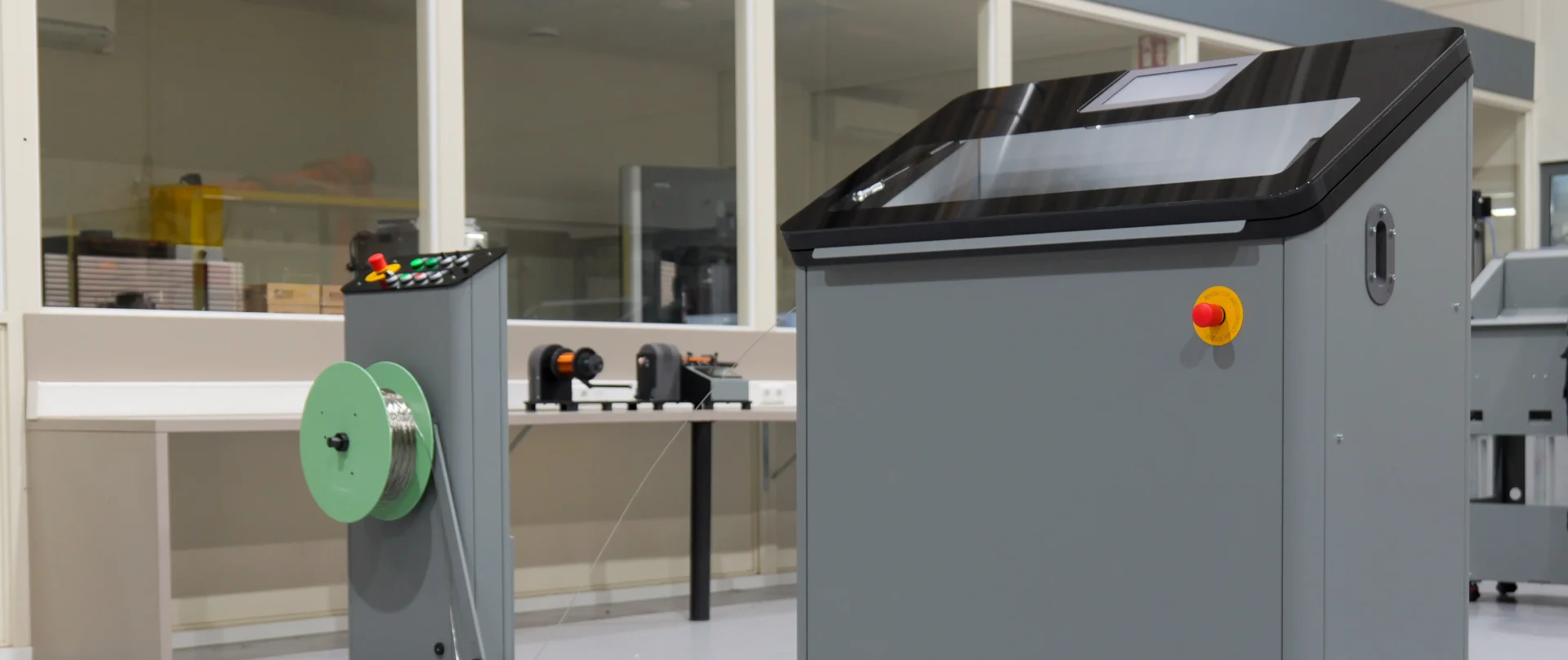
Mineral insulated (MI) temperature sensor manufacturing involves several sequential production steps, including MI cable handling, straightening, cutting, stripping, conductor preparation, welding, sealing and electrical testing. Many of these operations are traditionally performed manually and require skilled operators.
TMF develops modular automation solutions that automate these production steps one by one. Instead of replacing an entire production line at once, manufacturers can automate individual bottlenecks and gradually connect them into an integrated MI temperature sensor manufacturing process.
MI temperature sensor production is highly specialised work. Every manual operation requires time from a skilled operator. Increasing production output often means increasing labour capacity rather than improving process efficiency.
As demand grows, manual processes become difficult to scale. Automation allows manufacturers to increase output without simply adding more manual operations.
Most manufacturers have detailed work instructions. However, even with clear procedures, every operator develops their own working method over time.
Differences in handling, cutting, stripping or assembly can influence the final result.
For applications where accuracy, repeatability and traceability are critical, reducing operator dependency is an important advantage..
Producing high-quality MI temperature sensors requires knowledge and experience. Training new operators takes time, while experienced specialists are becoming increasingly valuable.
Automation does not replace expertise.
Instead, it allows skilled operators to focus on tasks where their knowledge creates the most value, while repetitive operations become more consistent and reliable
A typical MI temperature sensor production process can involve:
Automation solutions for individual production steps already exist. However, many available systems focus on solving only one isolated operation.
Manufacturers often encounter limitations such as:
The result is often a collection of individual tools rather than one integrated production workflow. We saw an opportunity to approach automation differently.
We believe complete automation should not start with replacing an entire production line. Instead, automation should grow logically from the real challenges manufacturers face every day. Every machine we develop starts with one question: Which production step creates the biggest bottleneck today?
Once that challenge is identified, we develop a solution that improves:
– Process consistency
– Production efficiency
– Operator productivity
Each machine is designed as a building block for a larger automation ecosystem. Step by step, individual improvements become a connected manufacturing process.
| Production step | Automation solution | TMF system |
|---|---|---|
| MI cable feeding | Controlled automatic spool feeding | SH-600 |
| Straightening | Automatic rotary straightening | CS-1100 |
| Cutting | Automated cut-to-length processing | CS-1100 |
| Batch sorting | Automatic job separation and collection | SC-1000 |
| Sheath preparation | Precision laser grooving | LG-500 |
| MgO stripping | Downstream stripping process | – |
| Laser welding | Future automation | In development |
| Sealing | Future automation | In development |
| Electrical testing | Future automation | In development |
Every machine in our portfolio was developed to solve a specific production challenge. Several developments started directly from customer feedback and real manufacturing situations.
One of the first challenges we addressed was one of the most fundamental steps in MI temperature sensor production: straightening and burr free cutting MI cable.
Manual cutting can be time-consuming and achieving consistent lengths depends heavily on operator experience. The CS-1100 automates this process by automatically straightening and cutting MI cable with high repeatability.
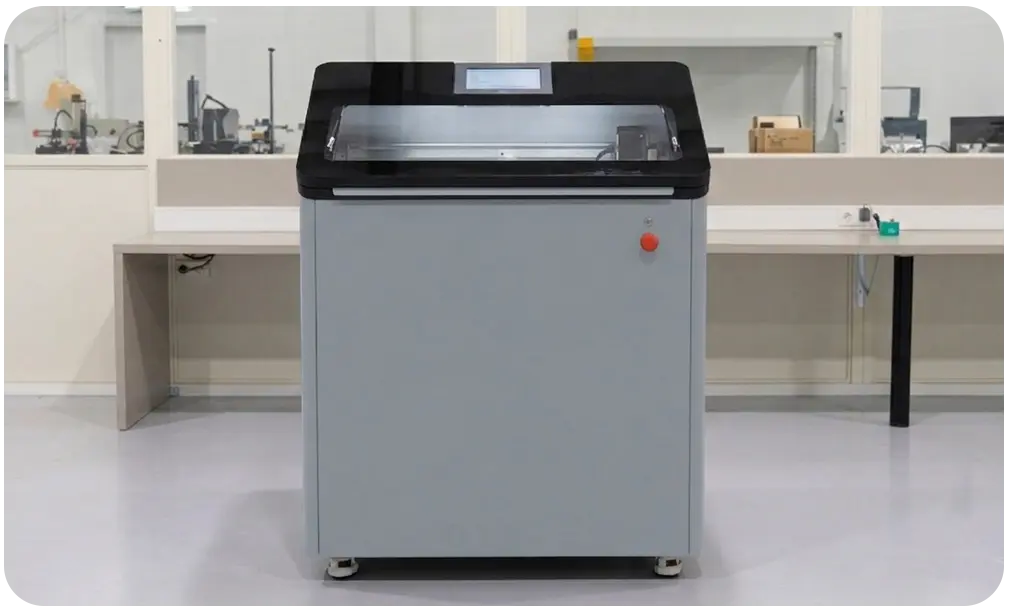
Automation does not only depend on the machine performing the operation. Material handling before and during the process is equally important.
Especially with smaller MI cable diameters, manual handling can result in uncontrolled winding and tangled cable.
This affects productivity and can influence the consistency of the cutting process. The electronic spool holder provides controlled and constant cable feeding.
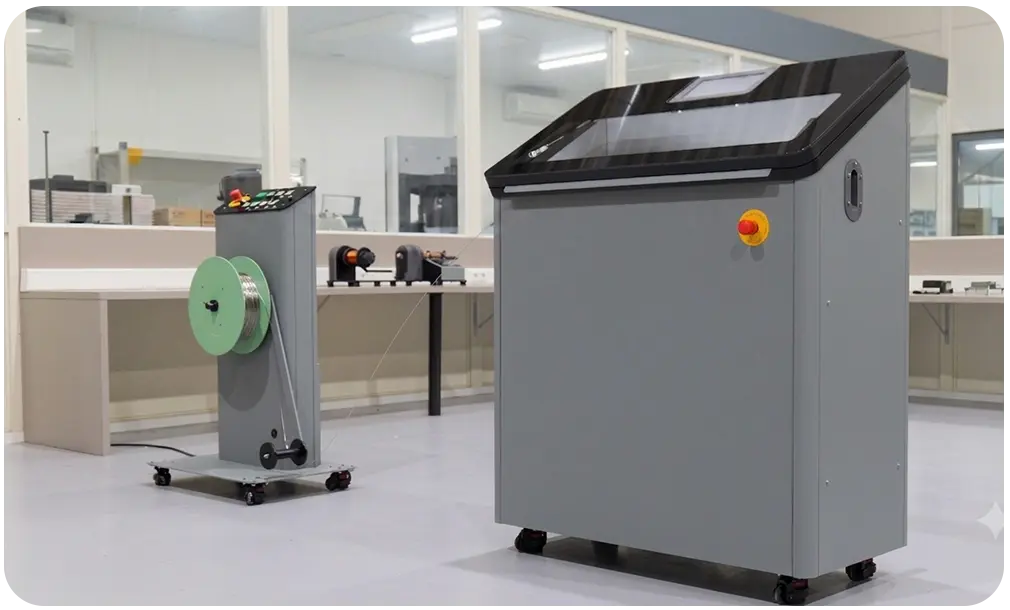
Automation does not stop after cutting. Handling and organisation are equally important parts of a reliable production process. The sorting carousel automatically collects and separates cut parts after processing.
The system communicates directly with the CS-1100, keeping production jobs synchronised. The machine continues working while operators focus on other tasks. The machine can be left unattended. When operators return, all cut parts are sorted into separate trays.
MI cable stripping remains one of the most challenging steps in sensor production. Traditional stripping methods may work well for specific applications, but manufacturers often require more flexibility and consistency.
Our laser grooving unit introduces a controlled laser groove into the MI cable sheath. This allows the cable tip to be removed quickly and accurately without damaging the internal conductors or MgO insulation.
The laser grooving unit represents an important step toward a more robust and scalable MI cable preparation process.
Looking further ahead, our ambition is to keep expanding the portfolio. Partly driven by what customers ask us for. Future developments may include junction forming and welding systems, seal-and-fill stations, and dry-bake thermal chambers.
We are not developing standalone machines. We are building a complete automation ecosystem, step by step.
All our machines are designed, built and assembled in the Netherlands. We have supplied customers across Europe and in the United States.
Because our machines are connected through an integrated network, we provide remote support wherever your facility is located. We have performed software updates remotely and assisted customers with diagnostics from a distance — so geography does not limit the support you receive.
Would you like to explore how automation could improve your MI temperature sensor manufacturing process?
Our team would be happy to discuss your current workflow and identify the next step toward a more efficient production environment.
